Friday, August 31, 2012

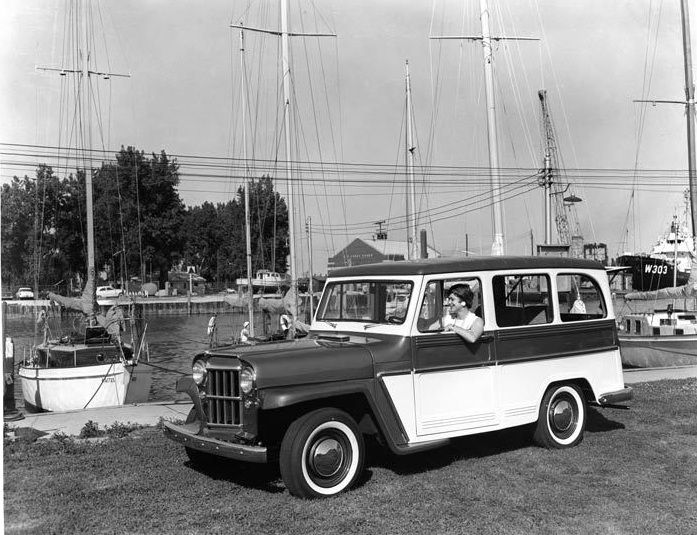
The Willys-Overland Station Wagon

During the mid-1940s one of the most talented industrial designers was harkened by Willys-Overland Motors to design the newest model in their fleet of utilitarian vehicles planned for the everyday working consumer. His name was Brooks Stevens and the automobile he designed was the Willys Jeep Station Wagon. 


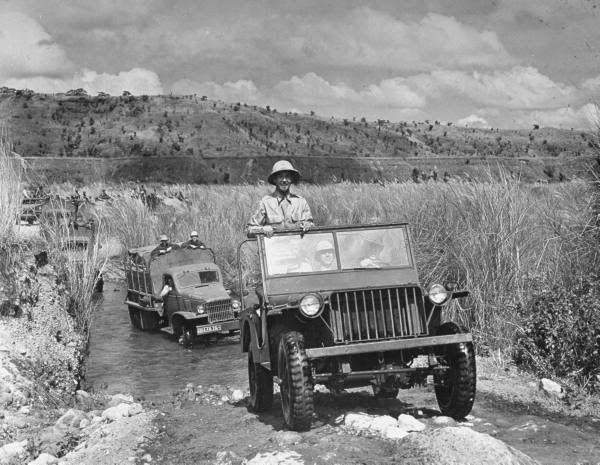
The Toledo-based manufacturing firm of Willys-Overland created the "Jeep" in 1941 - the first off-road four-wheel drive vehicle designed for the rough and tough day-to-day driving by American soldiers in every branch of the service during World War II. Originally known as the Bantam BRC-40 reconnaissance car it got it's nickname "jeep" by soldiers who dubbed it after Eugene the Jeep, Popeye the sailor man's jungle pet, who was "small, able to move between dimensions and could solve seemingly impossible problems". 


Willys-Overland Motors, teamed with Ford, churned out over 600,00 Bantams and when the war was over many of the young men, having been accustomed ( and impressed ) with its heavy-duty performance purchased their own "jeeps" for work use back in the States. 

It was in 1945 however that Willys-Overland hired Brooks Stevens, one of the most talented industrial designers of the 1940s, to design a station wagon that they could market to the mass....a vehicle for families that was both safe, sturdy, and reliable. A work-horse for the public. 
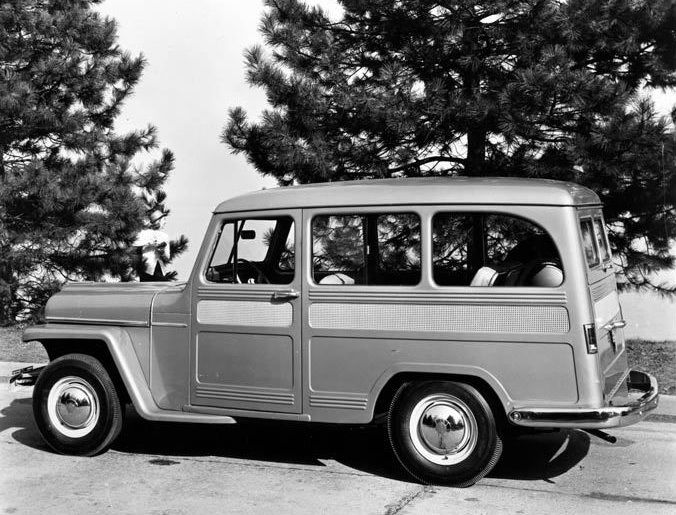


In the summer of 1946, fresh from the factory rolled out the all-new Willys-Overland Jeep Station Wagon "463". It was built with an all-steel body ( some had wood side-panel fronts to give them more of a "rustic" appearance ), a small four-cylinder engine and a very eye-appealing design. 
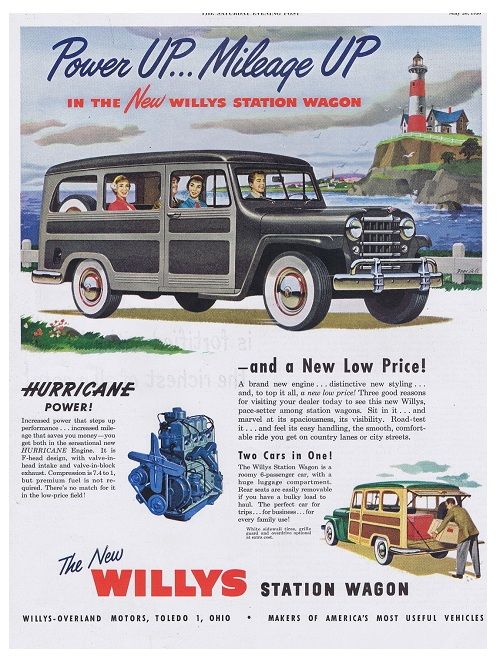


In 1948, the 663 model came out powered by a Lightning straight-six engine and the following year saw the first four-wheel drive model designed. The Willys-Overland was fast becoming one of the world's first popular sports utility vehicles. 

In 1950, the 473 got a new engine, the F-134 Hurricane, and a delivery van was added to the collection. While the station wagon continued to made up until 1965, it was finally dropped due to the introduction of the superior Jeep Wagoneer. 
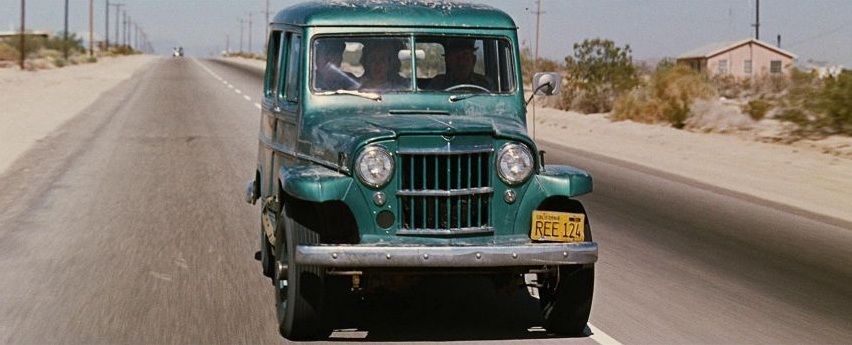


One of the later year models had a starring role in Stanley Donen's 1963 comedy epic "It's a Mad, Mad, Mad, Mad World" where it was driven by 'Colonel Hawthorne' ( English comic Terry-Thomas ) en route to the Big W at Santa Rosita Park. 

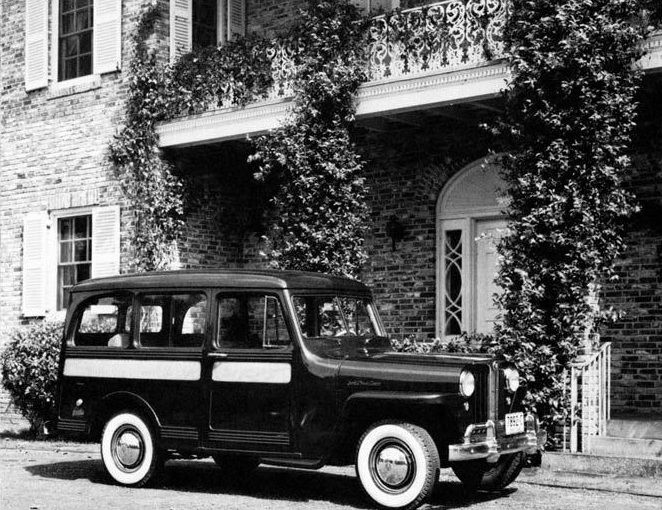
Steven's design was wonderful - not only did the station wagon look great on a farm, or a beach, or in the Claifornia desert..but even at the entrance to a stately manor it held its own and "belonged". Today it is relatively easy to come across a station wagon, but with its all-metal body, good luck finding one that isn't rusted through! 


Monday, August 6, 2012

Whittier Words of Wisdom

" Yet Love will dream and Faith will trust
Since He who knows our need is just,
That somehow, somewhere, meet we must.
Alas for him who never sees
The Stars shine through his cypress trees;
Who hath not learned in hours of faith,
The truth to flesh and sense unknown,
That life is ever Lord of Death,
And Love can never lose its own. "

                                                J.G. Whittier


Tuesday, July 3, 2012

Captain Nemo's Submarine - The Nautilus

Ahoy Mateys!

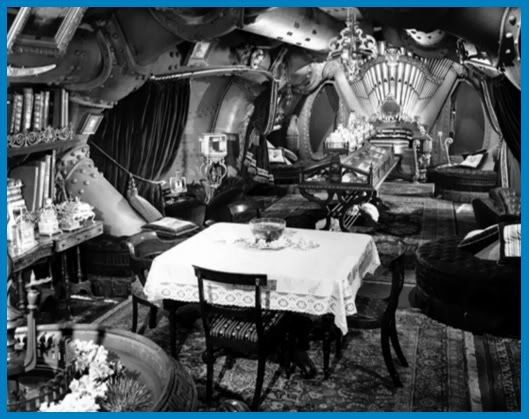
Captain Nemo's underwater mechanical marvel, The Nautilus, as featured in Walt Disney's "20,000 Leagues Under the Sea", is our featured interior this week because it is a wonderous example of Jules Verne inspired "Steampunk" set design.

"20,000 Leagues Under the Sea" was released in 1954 and was a bonanza at the box-office. It won an Academy Award for its stunning special effects ( including all those underwater diving sequences ) and for its Color Art Direction. Which as you can see below, it justly deserved.

John Meehan, the art director for this film had won 3 Academy Awards in his career for such beautiful films as Sunset Boulavard, and The Heiress. During the late 1950s he turned to television set design and worked on Alfred Hitchcock Presents, The Millionaire, Soldiers of Fortune and Leave It To Beaver.

Working alongside with him on "20,000 Leagues" was Emile Kuri, a very well known set decorator of numerous Walt Disney features. This was the beginning of his long association with the studio, but prior to this film he had worked as set decorator on many, many fine pictures : It's A Wonderful Life, I Remember Mama, A Place in the Sun, Fancy Pants, A Place in the Sun, War of the Worlds, Carrie, Shane, etc, etc.

Emile Kuri will be featured in a blog entirely devoted to him, right now let's begin our grand tour of the Nautilus....


The Structure of the Nautilus

The Nautilus had three different levels : the first containing the workings of the ship ( the ballasts, pump room, and power supply ) as well as the Outfitting Room and Diving Chamber. This is where Captain Nemo and his blue crew would prepare themselves for sojourns beyond the Nautilus, such as underwater hunting expeditions, outer hull repairs, and those not-too-uncommon burials at sea.

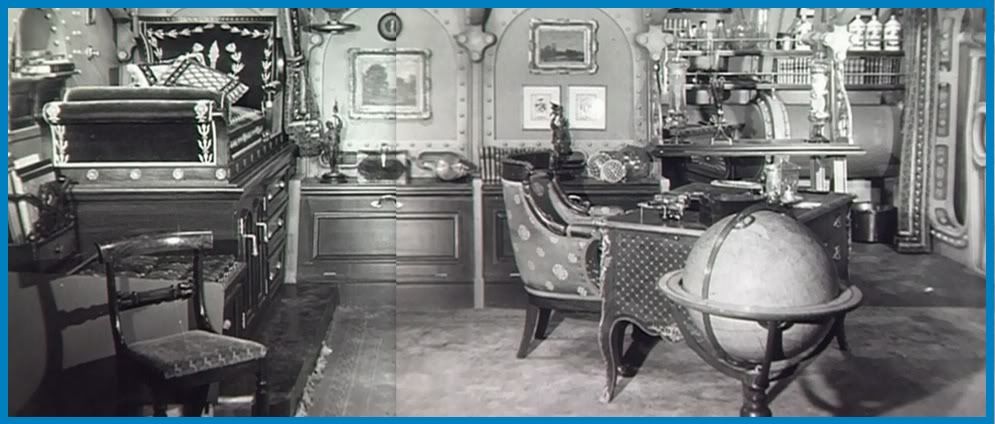
The middle level contained the Galley, where delictable delights such a Seaweed Salad were prepared for Nemo and his guests, as well as the Passenger Cabins. For common "seaman" this was nothing more than a bunk and washstand in a room enclosed with pipes, but for more distinguished guests ( such as the Professor ) it was quite decorative with a wood carved bed, mahoghany desk, and even pictures on the wall. Ooohh.

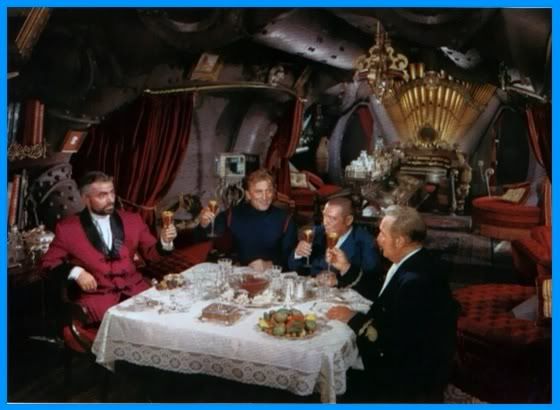
The Main Dining Room
Above was the main level where the arsenel ( complete with underwater spear guns ), chart room, salon, and Captain Nemo's cabin were placed. The Salon was the plush living room/dining room of the Nautilus. It was decorated in the traditional style of the Victorian era - ornamental rugs, rich red velour sofa seats and drapes, miniature statuettes and water fountains, and in place of the common upright piano, a mighty organ graced the room.


In the center of the salon was a display case which might of included specimens from some of Captain Nemo's hunting expeditions. And beyond this was the grand feature of the salon - the circular viewing window. Although Nemo had works of art scattered throughout the Nautilus this viewing window showed the most beautiful picture of all : the wonderous world of the deep.


The Captain's Quarters

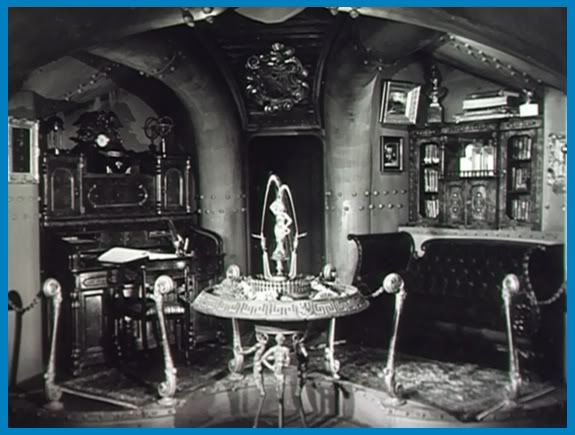
But even though the Nautilus was a beautiful submarine throughout ( albeit a bit overly iron ) the BEST decorated room of all was Captain Nemo's very own quarters. After all, it was his ship so why not have the best suite?

This lovely room was cheerful and yet quite masculine in style. Nemo slept on a traditional sea captain's bed which was a single bed atop numerous drawers ( something we all should use ). He had a magnificently ornate writing desk, a globe of the world at hand, and a map of his world - the underwater world - hanging opposite his desk.

Captain Nemo's Room
If one was to step into this room one would never even think they were at sea. On days when Nemo would be feeling remorse and regret for the life he chose he could sit in his cabin and be transported once again to his home in England when he enjoyed peace and contentment, prior to his wife and children's accident.

James Mason and Paul Lukas
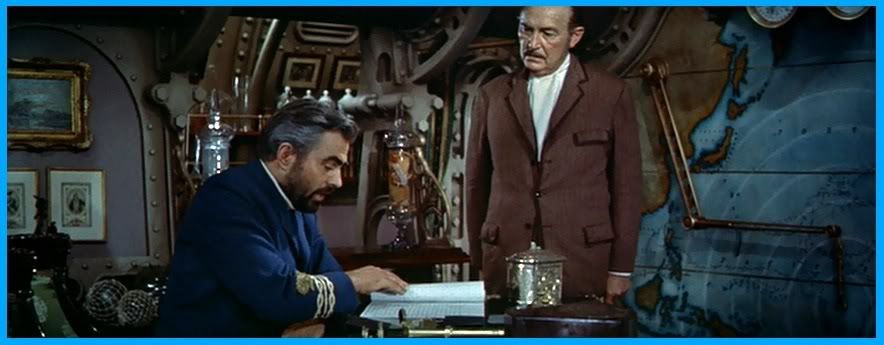
And finally, to conclude our tour of the Nautilus is the wheel house ( shown in the topmost photo ). No ship would be complete without a wheelhouse, the only place where a captain feels truly in command and can overlook his domain.

For the making of  "20,000 Leagues Under the Sea" several different sized models of the Nautilus were made. A full-scale replica was built for the filming of the interior sequences. Shortly after the film was released, a 20,000 Leagues Under the Sea attraction opened at Disneyland. Visitors could see the largest of models on display, read about Nemo's important scientific research he was conducting, walk thru a replica of the sets used in the film, and awe at the giant squid about to attack your sub....all for only 10 cents.

Disneyland's 20,000 Exhibition
The exhibit existed from 1955-1966 and was a pleasant addition to the Submarine Voyage ride at Disneyland, where you could journey through Nemo's deep blue sea too in miniature versions of the Nautilus just like he did. Unfortunately that ride ( and the one that was built in Walt Disney World ) have both been closed down, due to a lack of modern Victorian voyagers.

The Main Salon, from the 20,000 Leagues Exhibit
The original organ used for the film can still be seen though, at the Haunted Mansion ride at Disneyland. Duplicates exist at the Walt Disney Worlds of  Orlando, Paris and Toyko ( where by golly, Nautilus rides are still popular ).

The mighty organ that played those eeeeerie tunes

Six years after "Twenty Thousand Leagues Under the Sea" premiered another version of The Nautilus was designed for Ray Harryhausen's adventure extravaganza "Mysterious Island" starring Gary Merrill, Joan Greenwood, and Michael Callan and Herbert Lom as our mysterious Captain Nemo. This one designed by art director Bill Andrews. The design of the ship was obviously copied off of 20,000 Leagues because the main lounges are very similiar in style. The "working" part of the ship was different though and included an aquarium where Nemo demonstrated a method of how the stranded passengers could rescue a sunken pirate ship and return to civilization.

Herbert Lom, as Captain Nemo in "Mysterious Island"
Numerous versions of Jules Verne's adventures featuring Captain Nemo have been brought to film, some as early as 1910. And each one of them had a unique stylization of the Nautilus, but I think Walt Disney's was the best because it captured perfectly the vision a Victorian would have of the Future in design. What's known today as "Steampunk" ( another topic we'll cover later mateys ).

The Outfitting Room of the Nautilus as seen in
Mysterious Island (1929 ) with Lionel Barrymore

** Note** : This was just a reprint of a post that I wrote back in January for my "Drafting a Design" blog. I've been too pooped to post lately..but I'll come up with something fresh soon.

Tuesday, June 19, 2012

Silverbanks Pictures is Launched!

Weeee!! It's finally here! It's finally started! 


"What's finally started?" says you. 
" Silverbanks Pictures!" says I. 


Okay, let me start from the beginning. Way way back in March, my sister and I decided to finally...ahem...work - and wanting to start a business that we would enjoy doing and as well as one that would give us the opportunity ( and I must say, the pleasure ) of staying home, we hit upon the idea of being movie photo dealers. 
One of the many original stills we'll be selling in the near future.
We purchased several hundred stills and 8x10 reproductions, and now after 3 long months  we've finally launched our "official" website....


http://www.silverbankspictures.com


Here's a peek-a-boo at the site : 


It's not really looking the way we want it to just yet, and we haven't posted many stills in our store ( okay, we haven't posted ANY yet ) but we're happy for now. Check out our eBay store HERE to see more of our merchandise. It's really more of a blog than a e-commerce store, and hopefully it will remain that way. Later on, we'll be adding more whistles and bells and downloadable freebies. I just couldn't wait to get the word "out there"..floating about in cyberspace, so I'm doing my barking bit early. 


Monday, June 18, 2012

An Armchair Traveler's Favorite Quote

Imagination is as good as many voyages - and how much cheaper.  


                                                                                       - George Curtis


Thursday, June 7, 2012

Kingwood Gardens

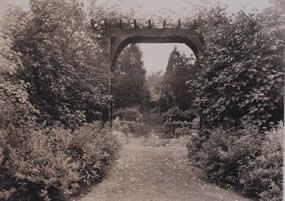
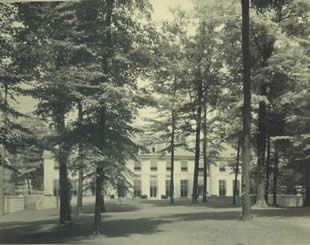
We haven't gone on a tour of the Great North ( northern Ohio, that is ) in quite a while so today's blog mateys is going to be about Kingwood Manor. One of my favorite public gardens. This  beautiful French Normandy styled estate is situated among 47 acres of lovely, lush gardens, right smack in the heart of Mansfield, Ohio...about 70 miles north of Columbus. 


Kingwood Manor was built in 1926 for Mr. and Mrs. Charles Kelley King who made his fortune working in Mansfield with the Ohio Brass Company. He started as one of their first electrical engineers in 1926, and later led the company into new ventures ( such as manufacturing electrical fittings for trolleys ) until he eventually became President of the Ohio Brass Company. 


The estate was designed by prominent Cleveland architect Charles Mack, who made quite a name for himself creating beautiful homes in Shaker Heights and Lakewood. Later on, he moved to Palm Beach, Florida and made his stamp on the architecture of that lovely city as well.


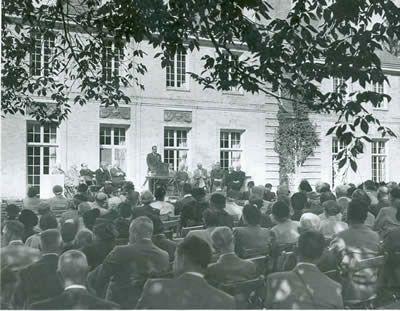
A year after his wife passed away in 1952, Mr. Charles King dedicated Kingwood Manor as a public garden.


Dedication Ceremony, 1953
Much of the house remains unchanged from the late 1920s. It is open to the public for tours ( at $1 per person ) and contains, in one of its upstairs rooms, the horticultural library of Mr. King.


Today Kingwood Center continues to thrive as a educational and cultural center with special emphasis on ornamental horticulture and gardening. It is open to the public from April 14 through October 14. The gardens are FREE and there is a $5 ( per car ) parking fee. 


Take a drive out there and enjoy this beautiful landmark!


Located at 900 Park Avenue West, Mansfield, Ohio.


Monday, May 28, 2012

The Film Music of Richard Addinsell

The first composer to be featured in our British Music Series can be considered a prime example of a composer of light music as well as film. Richard Addinsell excelled in both fields equally and hence he is the first and foremost choice of mine to be featured in this exciting new series. Well....at least it's exciting for me, it may be a bit of a yawner for me readers.

The Warsaw Concerto is Addinsell's most famous and oft performed composition. It was written apart of the score ( or I should say, as the score ) to a little known film called Dangerous Moonlight ( 1941 ) starring Anton Walbrook. Prior to this Addinsell had wrote scores for Dark Journey, Fire Over England, The Lion Has Wings and Goodbye, Mr.Chips. 

The Warsaw Concerto's unexpected popularity ( it has been recorded over 100 times and had sales in excess of 3 million dollars ) was both a blessing as well as a curse because it's fame has obscured all of his other works; works that are just as magnificent and beautiful even if they aren't well known.

Richard Addinsell was born in London, England on January 13, 1904. After being homeschooled by his mother, he enrolled in the Hertford College in Oxford to presumably study law, but after only 18 months Addinsell quit and decided to focus his interest on music. He then enrolled at the Royal College of Music but only remained there a few months as well. His non-traditional educational upbringing made him restless at traditional schools and so he decided to pursue his own line of music study through "on-hands" learning. This proved just as good as a formal education. 

Goodbye Mr.Chips

After touring Europe he wrote incidental music for a variety of British plays and radio programs. One of these plays introduced him to Douglas Fairbanks Jr. who along with writer Clemence Dane, led him into the film industry in 1936 with the job of writing the score to The Amateur Gentleman. 

For the next 20 years Addinsell was kept busy writing film scores ( Love on the Dole, Blithe Spirit, Under Capricorn, Passionate Friends ) as well as some twenty documentaries for the Ministry of Information. A chance meeting with comedienne/actress Joyce Grenfell launched a lifelong friendship and collaboration with her on music for her one-woman shows. Between these film and stage projects, Addinsell was also busy doing work for BBC radio plays and television - where the bulk of his "light music" played as openings to shows. 

The Passionate Friends

The majority of Addinsells film scores prior to 1950 were destroyed by the studios ( a common practice, as they felt there was no use for them after a films release ) but many of these beautiful works were re-constructed from the films themselves by composer Philip Lane and have been performed by Kenneth Allwyn and Rumon Gamba and released as collections on cd. 

Below are just a few sample sound clips from some of Richard Addinsells large body of work. A quiet man in real life, he used music as a way to release his inner passion and the heart-felt emotions he experienced can be heard in many of his compositions. He also made frequent use of the piano in his music - being an excellent pianist himself - and this feature seems to make even his most ambitious of light classical pieces appealing to the mass audience. It also anticipated the piano/orchestra style later popularized during the 1960s by Ferrante and Teicher, and Roger Williams. 

Tom Brown's School Days - was written for the 1951 film starring John Howard Davies and Robert Newton.
Click here to play music

The Isle of Apples - is a  beautiful melody written in the English pastoral style. This miniature evokes a medieval reverie and it's title most likely refers to Avalon, the legendary burial place of King Arthur.
Click here to play music

The Smokey Mountains Concerto - First Movement - Addinsell rarely wrote music that was not assigned for a film or a stage work but this is one case that he did. It is a 15 minute piece written in three parts...First Movement, Valley Song and Old Joe Clark and captures the folk history of America.
Click here to play music

A Tale of Two Cities - Richard Addinsell had hoped that A Tale of Two Cities would of "taken off" as a success like Warsaw Concerto but it did not, and today even the film it was written for ( starring Dirk Bogarde ) is not remembered all that well. 
Click here to play music

Appleshaw's Allure - The title of this lovely song is actually Tune in G, but that was such a dull name I redubbed it Appleshaw's Allure. Appleshaw was the name of the country home where Addinsell's parents resided and where this song was first composed.
Click here to play music


Wednesday, May 9, 2012

British Film and Light Music Appreciation

As if we didn't have enough topics going on at once, today I thought of a marvelous idea.... a series of blogs on British composers. Especially....light music and film composers. If there is any field of music that gets overlooked it's Light Music. Wikipedia defines light music as "a generic term applied to a mainly British musical style of "light" orchestral music, which originated in the 19th century and had its heyday during the early to mid part of the 20th century. The style is a less "serious" form of Western classical music, featuring through-composed, usually shorter orchestral pieces and suites designed to appeal to a wider audience than more serious compositions. "

Yes, that pretty much sums it up. Where classical music can sometime be "above us" in it's composition, light music is always simple and refreshing while at the same time is very moving. In particular the pieces tend to capture a "mood" or an event, such as "A Day in the Park" and therefore are often referred to as "mood music" as well.

Composer Eric Coates
Light music originates back to the days of the operetta, but did not reach it's prime until the beginning of the early 1930s with the advent of radio. BBC Light Programme ( a radio station created in 1945 ) contributed greatly to the spread of this fine music and for the next 20 years the field reached it's halycon.

Light music is the music of choice to those who enjoy popular tunes but who do not quite have the...ahem..patience...for really heavy classical pieces.( People like me, that is ) The accentuation of the music is placed on melody and therefore even a classic music novice can enjoy these beautiful songs without feeling lost.

Some of the composers we will feature in this series will be Eric Coates ( the creme de la creme of light music composers! ), Ernest Tomlinson, Adrian Leaper, Robert Farnon, Ron Goodwin, Anthony Collins and Sydney Baynes.


AND since we're on the topic of England's finest musical masters we might as well cover that delectable slice of listening pleasure known as British Film Music. The list of legends in this field is practically unfanthomable but a sample of our warblings will include Ralph Vaughn Williams, Arthur Bliss, Charles Williams, Allan Gray, William Alwyn, Anthony Collins, Stanley Black, Clifton Parker., Richard Addinsell..and who can pass up Sir Malcolm Arnold? Not I!

These legendary composers created the rousing/compelling scores to such classics as "Sink the Bismarck"; "49th Parellel"; "David Copperfield"; "The Bridge on the River Kwai"; "An Ideal Husband"; "A Canterbury Tale"; "The Dam Busters" and "Scott of the Antarctic" as well as many, many others.

Each of these composers had a unique style which they contributed to every film, and which consequentily set the tone for the movie and made them as recognizable in theme as their composer's compositions.

Who can think of lovable Miss Marple ( Margaret Rutherford ) without hearing strains of Ron Goodwin's familiar harpsichord melody in their head?

Since I have no concept of order and organization I will just randomly write about these composers at whim....and hopefully by the end of the year will have covered enough composers to give me mateys a thorough overview of these wonderful fields of music. And with a goodly dose of digital music clips tossed in...who knows? you might just come to be as fascinated with the subject as I be!

Friday, April 27, 2012

Everyman's Car...The Brush Runabout

The Brush Runabout is our featured classic motor car this month. As with most of the early automobile manufacturers, The Brush Motor Company had its home in Detroit, Michigan. Alson Partridge Brush, its founder, was a very inventive fellow and to make his little runabout stand out from the other manufacturers "runabout" models of the era he added many clever new features to his Brush mobile, such as gas-powered headlamps, convientent tooting horn and solid oak and maple frames.

1912 Brush Runabout

Alson P. Brush had designed the first Oakland motorcar ( a forerunner of Pontiac ) and unique in his design, was that the motor was cranked counter-clockwise rather than clockwise..to decrease injury to the driver if the hand-crank kicked back. The Brush Runabout was powered by a large single cylinder water-cooled engine. Early models were 6 hp but this 1912 model was 10hp and capable of speeds up to 30 mph ( whoa nellie! ).

Several different variation of the runabout were marketed over time...the B, BC, D, E, F, M and Liberty, as well as several trucks used as US Mail delivery vehicles. Although, it was an inexpensive automobile ( $350 sale price ) and was quite reliable for its time, The Brush Runabout did not have a very long existance. The company was founded in 1906, but only six short years later it went through an unsuccessful merger with the United Motor Car Company and floundered.

About 10,000 Brush Runabouts were manufactured in total. You'll have to runabout to find one today though.

1909 Model D Runabout


Saturday, April 21, 2012

The Wise Man's Freedom

The timid it concerns to ask their way,
And fear what foe in caves and swamps can stray,
To make no step until the event is known,
And ills to come as evils past bemoan.
Not so the wise; no coward watch he keeps
To spy what danger on his pathway creeps;
Go where he will, the wise man is at home,
His hearth the earth, - his hall the azure dome;
Where his clear spirit leads him, there's his road,
By God's own light illumined and foreshowed.

                                                Ralph Waldo Emerson

Saturday, March 24, 2012

Rudyard Kipling's KIM

1885 Lahore, India: Colonel Creighton, head of the British-India Secret Service receives a report that the Russians are planning an attack on India via the Khyber Pass…where and when they plan on attacking is unknown. With the help of “Red Beard” Mahbub Ali, their top agent who disguises himself as a horse trader; the “Fat Man”; and an orphan English boy named Kim they try to uncover the Russian’s plan before it is too late.
Rudyard Kipling’s thrilling adventure novel “Kim” was brought to the screen in 1950 in brilliant eye-popping Technicolor and boasted a splendid cast with Errol Flynn as the magnificent Red Beard, Cecil Kellaway as the Fat Man, Paul Lukas as the Holy Man ( a Tibetan monk with an unusually strong Austrian accent ), and Dean Stockwell as our boy-hero Kim -  a young man who learns how difficult it can be to play the Great Game of spying.
              
Filmed on location in Rajasthan and Utter Pradash, India ( as well as Lone Pines, California ), the movie gives us a tour of India during the Age of Imperialism, when British troops paraded on grounds outside city walls, and wily dangerous characters lurked in dark corners of crowded sadaks.
The rights to Rudyard Kipling's popular adventure novel were purchased by MGM in the mid-1930s with the intention of casting Freddie Bartholomew in the title role. For unknown reasons, this project was abanoned and not taken up again until the late 1940s.
During this time, Errol Flynn was loaned to MGM from Warner Brothers for two pictures. The first one was "That Forsyte Woman" where opposite Greer Garson he was cast as the unloved Soames Forsyte. His second feature though, was a choice between "King Soloman's Mines" or "Kim". Both were to be filmed on location. Errol opted for India over Africa, and the lead role of Allan Quartermain in "King Solomon's Mines" was turned over to English actor Stewart Granger. In a very enjoyable version of the story too, if I say so meself.

“Kim” on the other hand is a wonderful adventure film – enjoyable for all ages – but alas, it fails to be a truly memorable film, mainly due to its heavy reliance on voice-over narration rather than pictures and dialogue. However, when there is dialogue it is spoken right from the pages of Kipling’s novel and pleasantly plays on the ears in lyrical fashion.
“ You should believe only your eyes…and not the voices of others.”
“ This is a child’s game, Mr.Luzor “
“ It is part of a Great Game “.
Sir Robert Baden-Powell, the famous British Army scout and founder of the Boy Scout movement, would of fully approved of the lessons this film teaches…..key lessons on observation and judging character; always being prepared and aware of one’s surroundings.
                           
Dean Stockwell is particularly noteworthy as the English sahib living life as an Indian boy. Devoted to his Holy Man, Kim acts as his chelah ( a servant to a monk ) while travelling across India with him in quest of the sacred River of the Arrow.  Begging on the streets, climbing across rooftops, cursing passerby’s, and donning a dark tan, he is an unlikely suspect to his enemies and hence...becomes a master player of the Great Game.

Friday, March 23, 2012

A Pythagoras Quote

What have I learnt where'er I've been,
From all I've heard, from all I've seen?
What know I more that's worth the knowing?
What have I done that's worth the doing?
What have I sought that I should shun?
What duties have I left undone?

PYTHAGORAS